Reflections
A Camera From 1966

For the past two weeks in southern France, I carried a small Canon EE17 half-frame film camera instead of my usual professional camera and full set of lenses. A few rolls of Kodak Gold 200 and Portra 400, with a fixed 30mm lens.
There were times I forgot to set the zone focus on the camera and had to re-shoot the picture. Part of that was getting used to a new (old) tool, part of it was adjusting to the speed I’m used to moving through things. These cameras were manufactured between 1966 and 1971. In a way, I was learning to move at a different pace—slower, more deliberate, analog—imposed both by the mechanics of the camera and my own decision to be more attentive.
As Sarah and I wandered through villages and countryside, when a scene or composition caught my attention I had to be intentional about each frame—metering the light, composing for angle, balance, perspective, and trusting my choices without immediate feedback. And because it was film, I rarely shot multiple versions of the same scene.
I didn’t realize how much my attention had been shaped by speed until it was gone.
We landed in Nice and made our way down to Saint-Mandrier-sur-Mer. The airport, the rental car counter, the first conversations in French—each step required a kind of slowing down I hadn’t fully anticipated. Unfamiliar road signs and the different rhythms of traffic made me more cautious and slowed my typical pace. At one point, my niece—one of two traveling with us before we met the rest of the family at the house—all but diagnosed me with an anxiety disorder.
The grocery store was its own kind of adjustment. Understanding the produce scales, unfamiliar measurements, unfamiliar currency—it all asked for more attention than I usually give to ordinary tasks. We moved through it together, learning as we went, practicing patience, laughing at ourselves a little. At moments I found myself taking the kind of slow breath I often suggest to clients when their nervous systems begin to feel overloaded.
Our week together fell into a rhythm I needed after the intensity of graduate school and my first two years of seeing clients. Mornings on the porch with coffee and binoculars, spotting European species of birds to add to my life list. Morning trail runs (sometimes just walks to the bakery for croissants). Afternoons on the beach with Sarah and her sister’s family. Evenings spent together playing games, or simply being together as the day settled.
Walks through the woods, afternoons on the beach, wandering through small towns—the small camera stayed strapped to my side. It asked for very little. No changing lenses, no charging batteries, no reviewing images, no editing, posting, or sharing. Only attention, then a decision, then the click of the shutter, the winding of film, and moving on.
After Saint-Mandrier-sur-Mer, Sarah and I traveled inland from the sea to Lourmarin in the Luberon district. Vineyards covered the valleys; stone villages, the hills.
One morning I left early for a bird-watching hike in Buoux, about twenty minutes north. The trail wound through woodland and along water, then into stone structures from the Middle Ages—walls and dry-stone shelters called bories—still holding their shape after hundreds of years. Birdsong filled the air. The place felt both inhabited and empty, worn by time and use.
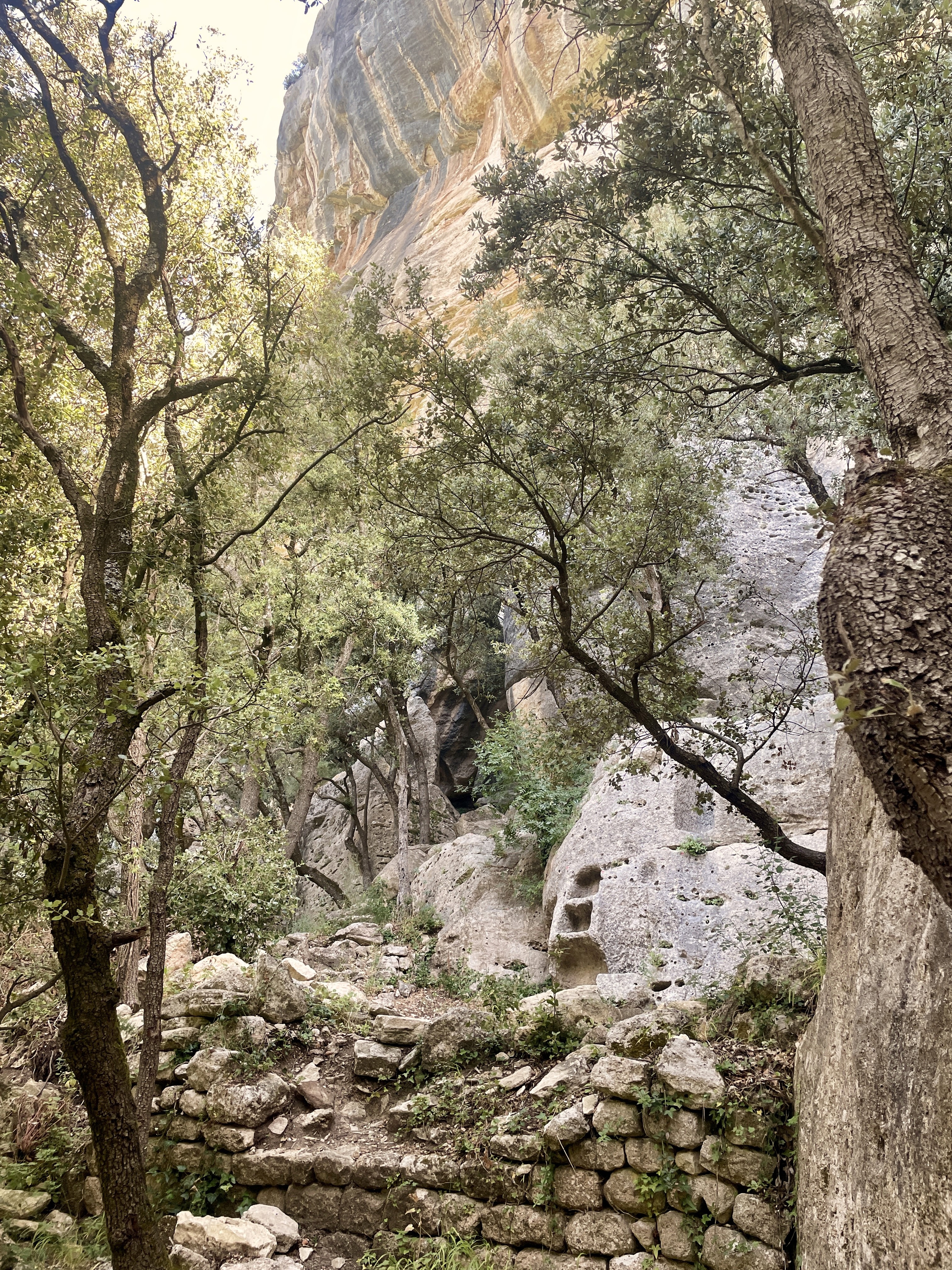
I still hadn’t seen a European Robin. I’d heard them on a hike days before, but I hadn’t seen one. That morning I thought I might.
Each time I entered a clearing, when the trees opened above me and the light filtered through, I would stop. I listened. I softened my gaze toward the sound—trying to locate a small movement, a possible flitting between branches. But it never appeared.
Near the end of the hike, walking back toward the car, I found myself whispering a prayer—asking God for a favor. I was hoping God might want me to have the experience of seeing the bird. If I paid close enough attention—and if there was favor toward me—the robin might appear.
Nothing came.
The vineyards that surrounded us were beautiful—stone estate buildings set into the hills, with long rows of vines stretching out across the land.
One afternoon we visited a couple of the vineyards near us. After exploring the grounds, workers led us through tastings, pouring their signature wines with brief explanations, one at a time, for us to sample. We moved through the tastings slowly, not saying much—partly because we didn’t know much about wine, but also because just tasting it was enough. We left with a bottle from each vineyard.
At one point, I thought of my dad. He loves places like this—open land, sunshine, vineyards, and things grown from the earth. Especially wine.
The next day, on a morning walk, I visited Camus’ grave in the cemetery just down the hill from where we were staying.* Besides the birds and cicadas, the path was quiet—cypress trees, stone, the stillness of a place set apart from the day around it.
The grave itself is simple. A flat stone marked only with his name and dates: ALBERT CAMUS, 1913–1960. A large oleander bush and lavender grew over the grave, with disorderly weeds and flowers growing where they pleased. Small stones had been placed on top of it, most with names or small messages written on them.

I found myself scanning nearby graves, half wondering if I might recognize my own last name, thinking how strange and good it would be if some part of my distant French family were buried in the same ground.
I stayed for while. Before leaving, I picked up a small stone, wrote on it—“keep going”—and placed it with the others.
I walked back down toward the village, thinking about how ideas can outlast a lifetime, and how much of life is spent learning what to pay attention to while we’re here.
Looking back, I can see a shared thread running through these days, though I wasn’t aware of it while I was in them.
Attention changed depending on what constrained it.
With the camera, attention was shaped by constraint. One lens. A single frame, metered, shot, and left alone. No review. There was no return to it in the moment. It forced a kind of completeness into each act of seeing.
On my hike in Buoux, attention was unresolved. I was looking, listening, waiting for something just at the edge of sight. The more I tried to locate it, the more it stayed out of reach. Even with so much to notice, my attention organized itself around the one thing that was missing.
With Sarah, with family, at the vineyards, and later at Camus’ grave, attention widened in a different way. It was shared, or stretched across time—held in conversation, in silence, in tension, in other lives moving alongside or beyond my own.
None of these were the same kind of attention. But each of them changed how I was present.
I didn’t understand that while it was happening. Attention behaves differently depending on what constrains it—what it is given, what it is denied, and what it’s asked to hold.
The robin never appeared. The photos may or may not be any good. The bottles of wine we carried home will eventually be empty. The stone I left on Camus’ grave will be moved by weather or by another hand.
During these weeks I wore a pair of shoes with SLW DWN stitched onto the heels. I found myself noticing the words more than once—a reminder to me, and maybe to anyone walking with me.
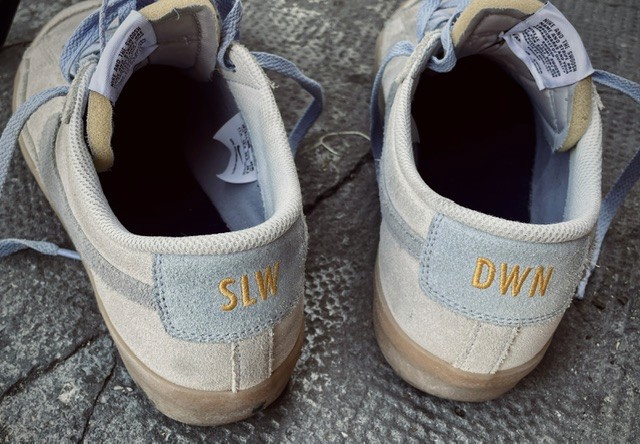
Modern life has a way of making real attention feel scarce.
As I return home, I hope to keep shooting film, one frame at a time, on this little camera with all its beautiful constraints. Maybe I’ll learn to appreciate limits rather than resent them.
Not efficiency. Not productivity.
Attention.
*Albert Camus (1913–1960) was a French-Algerian writer whose work has influenced me for many years. Existential psychotherapy, which draws from many of the same questions Camus wrestled with—meaning, freedom, responsibility, suffering, and mortality—is one of the foundational perspectives in my work as a therapist.
**Props to my brother, Steve, who inspired me to get these shoes. On the back of his, he’s got OTB EAST, his frisbee shop in PA. Check it out.
Begin Here
You don’t have to navigate everything on your own.
Whether you’re feeling stuck, overwhelmed, disconnected, or simply wanting to understand yourself and your relationships more deeply, therapy can offer a space to pause, reflect, and move forward more intentionally.