Reflections
The Sun Does Shine: On Attention and Freedom

Summer has a way of making me think I need to escape the ordinary. Wendell Berry recognized something similar in Wheeler Catlett, a character in his fictional town of Port William. “For every day he lived,” Berry writes, “he could imagine two or three others that he would like to live, if he did not have to do what he had to do.”
I feel a creeping dissatisfaction with the ordinary when I start imagining other lives I might be living—lives with more money, less complicated relationships, a different body, a different car, grass without weeds. And before long, shame often starts to bubble up inside me. But earlier this week, a man who spent nearly thirty years on death row challenged that way of thinking.
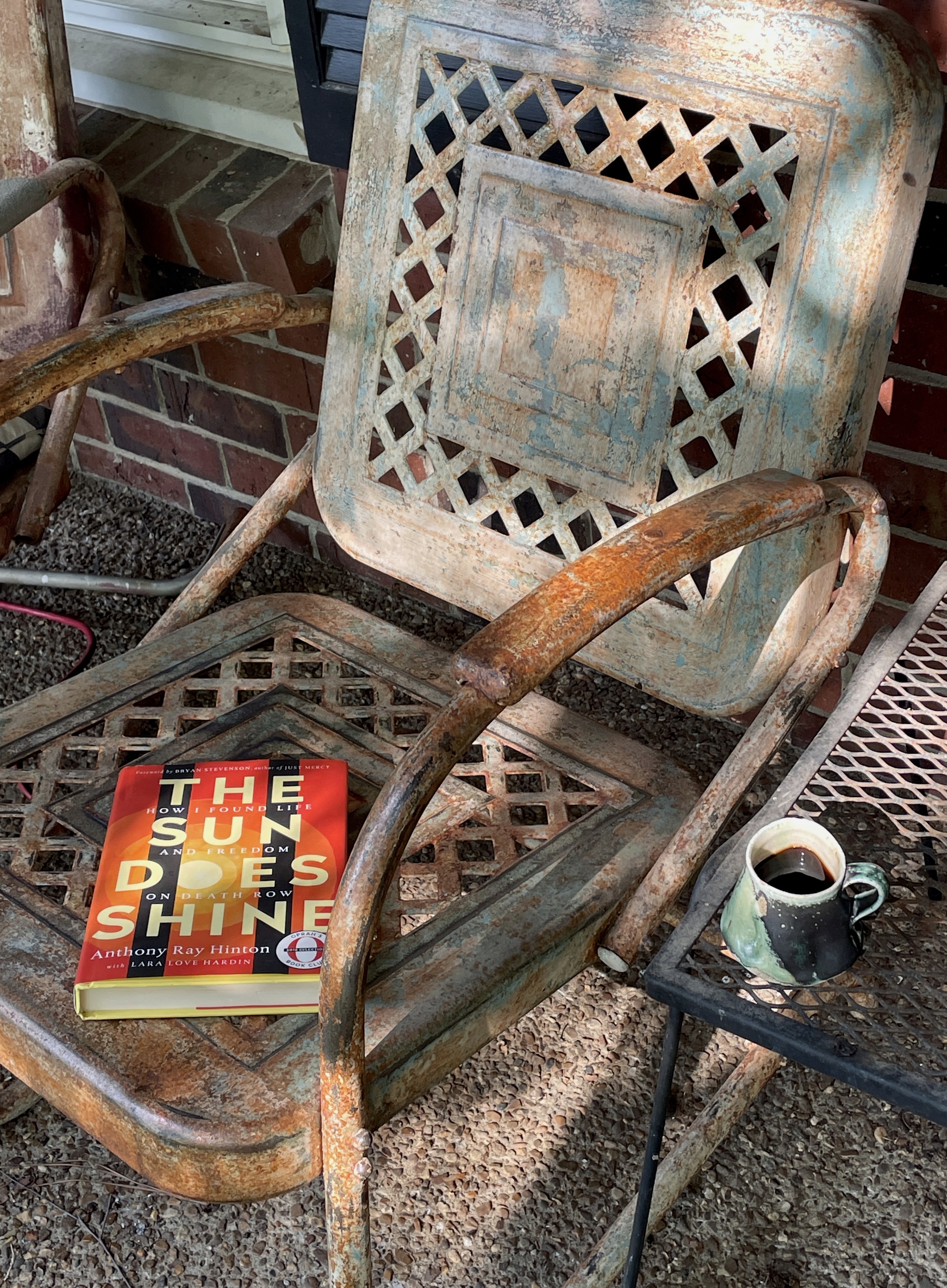
My mornings, when I’m not out running, are sometimes spent on the front porch with coffee and a book. I try not to bring my phone out there, so it’s just me and the birds, maybe my dog Georgia, and a neighbor or two walking by.
Last week I started The Sun Does Shine by Anthony Ray Hinton. On this particular morning, I had reached the part where he has just been wrongly convicted of multiple murders and sentenced to death. What followed was a description of his despair and disbelief in the prison cell—and then a raw reflection on what he wanted: to cut the grass, go fishing, watch the sunset, feel the kisses of his girlfriend, feel rain on his neck, take a walk at sunrise, drink sweet tea, eat his mom’s grits and cobbler, sleep on a soft pillow, drive his car, joke with people.
He writes, “I wanted my dignity. I wanted my freedom. I wanted to cut the fucking grass in my own backyard without the police showing up to haul me away. I wanted justice.”
Hinton describes how his new reality stirred up a violent desire to kill the prosecutor who orchestrated the corrupt case. And how that feeling was like a gut punch. Reading his list of simple everyday pleasures, and seeing how they surrounded me, was my own kind of gut punch. I looked at my grass differently. My porch. The cup of coffee in my hands. The sky above me. My neighbors walking by.
I felt a little frozen in that moment. As my coffee continued to cool, I just sat thinking about what I’d just read. Then, looking around, I noticed the river birch in my yard was still, its leaves only moving slightly in the breeze or as the wrens and chickadees flitted from branch to branch. I hadn’t moved, but I felt the weight of my body supported by this old metal chair in a way I hadn’t noticed before. I had a space that was mine. I sat there longer than I intended, but I was free to sit as long as I wanted.
The actual physical presence of Anthony Ray Hinton is warm, steady. Almost a year ago, two of my dear friends, Beth and Chad, co-directors of Porter’s Call in Franklin, TN, invited him to speak at their annual fundraiser, Evening of Stories, which I attend every year.*
There was something very special about being in that room and listening to his story. Several things hit me at once—my own sense of privilege, knowing what happened to him is likely something I’ll never have to suffer through; anger and sadness that things like this are happening all around us because of enduring racism and systems that keep it in place; and something harder to name. A kind of awe—how someone can live through that hell and still stand in front of a room and speak without bitterness.
Some colleagues and I—some of whom I also went to grad school with—have a therapist book club. My friend Grace started it. We meet at the Coffee House in downtown Franklin about every six weeks. We alternate between more clinical or theoretical books and memoirs with mental health undertones.
These last two memoirs we’ve read also tell stories of people whose world narrows or is taken from them, and then rebuild it through education, distance, and new forms of attention.
The first was Educated by Tara Westover. It tells the story of a young woman growing up in an isolated, survivalist family in Idaho, where formal education is rejected and much of what she experiences is shaped by a tightly controlled version of reality that doesn’t line up with the outside world. By leaving home and going to college, she begins to rebuild what she can trust and how she sees the world.
Like Hinton, her story is in part about what happens when a person’s world is reduced, and what it takes to recover a wider sense of reality and self. Even inside that confined world, she is still adapting—drawing on whatever parts of herself remain available in order to survive and make meaning of what is happening.
The second memoir, The House of My Mother, describes a different kind of confinement. It tells the story of growing up inside a family shaped by a mother’s control and distortion, where abuse makes reality difficult to discern or trust, and life has to be navigated by reading moods, avoiding conflict, and making constant adjustments.
Shari’s story is about what happens when a person’s world is shaped in ways that distort what can be seen as real, and what it takes to begin seeing clearly again. Survival often requires a person to pay attention in very specific ways—to moods, danger, unpredictability, or the expectations of others. Those ways of paying attention can keep us alive. But when the danger has passed, they don’t always know how to let go. Part of healing becomes learning to notice the world differently again.
When we’ve lived through danger, betrayal, or chronic unpredictability, our attention often becomes organized around scanning for what might go wrong. We become good at noticing shifts in mood, subtle signs of conflict, disappointment, or threat. Those ways of paying attention are not defects; they’re adaptations. They helped us survive emotionally, psychologically, and sometimes physically.
The difficulty is that our nervous system doesn’t always get the memo when the danger has passed. Learning to slow down, to become responsive instead of reactive, and to notice beauty, goodness, and ordinary pleasures can take years. Healthy relationships and therapy can often help the process along.
As I think about these three stories, I realize they all describe some form of captivity—not all of it behind bars on death row. Some is ideological. Some relational. Some becomes embedded in the nervous system itself. Each one changed what its author learned to pay attention to. And each one, in different ways, is also a story about learning to see more than survival allowed.
The ways of paying attention that help us survive aren’t always the ways that help us live. Sometimes it takes suffering to interrupt the habits of our attention and remind us what matters. Suffering isn’t the only way to shift attention. Conversations can. Therapy can. Friendship can. Sitting on the porch with coffee and a book can too.
—————
Notes:
Porter’s Call: A place where artists can find support and encouragement, specifically attuned to their unique profession. It’s a safe and confidential refuge where they can deal with the issues and stresses they face in their careers and personal lives. And the services are provided at no charge. Find out more about the organization and their Evening of Stories here: PortersCall.com
Anthony Ray Hinton walked out of the Jefferson County Jail in Birmingham, Alabama, a free man for the first time in 30 years at 9:30 a.m. on Friday, April 3, 2015. “The sun does shine,” he said as he was embraced by family and friends. One of the longest serving death row prisoners in Alabama history and among the longest serving condemned prisoners to be freed after presenting evidence of innocence, Mr. Hinton was the 152nd person exonerated from death row since 1983. Thirty years ago, Mr. Hinton was arrested and charged with two capital murders based solely on the assertion that a revolver taken from his mother’s home was the gun used in both murders and in a third uncharged crime.
“Race, poverty, inadequate legal assistance, and prosecutorial indifference to innocence conspired to create a textbook example of injustice. I can’t think of a case that more urgently dramatizes the need for reform than what has happened to Anthony Ray Hinton.” —Bryan Stevenson
from Equal Justice Initiative - read more here: Equal Justice Initiative
Begin Here
You don’t have to navigate everything on your own.
Whether you’re feeling stuck, overwhelmed, disconnected, or simply wanting to understand yourself and your relationships more deeply, therapy can offer a space to pause, reflect, and move forward more intentionally.